SitecoreAI & the End of Composable Paralysis: Why 2026 Will Split Digital Leaders Into Two Camps
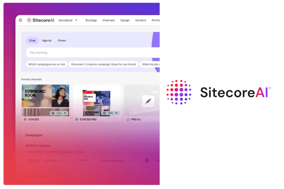
SitecoreAI solves the core problem enterprises now face: fragmented composable stacks make AI ineffective, slow teams down, and block digital transformation.
By unifying content, data, personalisation, search, and AI agents into one platform, SitecoreAI removes integration debt and creates a single, connected system that finally lets AI operate with full context.
The thesis is simple: unified, agentic platforms will outperform fragmented composable stacks — and the organisations that adopt SitecoreAI early will move faster, execute better, and win in 2026.

SitecoreAI & the End of Composable Paralysis
The uncomfortable truth nobody wants to say out loud
Most enterprise digital teams aren’t stuck because their CMS is slow.
They’re stuck because their systems don’t talk.
For years, composable was pitched as the safer, scalable alternative to monolithic DXPs. “Pick what you want. Swap out what you don’t.” It sounded like empowerment. What leaders actually inherited was:
-
Four or five contracts for what used to be one
-
Endless middleware stitching everything back together
-
Data trapped in silos that AI can’t interpret
-
Teams spending more time moving content between tools than producing it
-
Personalisation initiatives that die before they launch
-
Stacks that look modern but behave like legacy
This isn’t a technology failure.
It’s an integration tax — and AI just made that tax non-negotiable.
AI is accelerating content creation, but it’s slowing everything else down because context is scattered across tools that don’t share memory. The result? A lot of output, very little impact.
Something had to give.
The moment composable stopped working
Composable didn’t fail. It plateaued.
It scaled horizontally — more tools, more vendors, more options — but not vertically. It never solved the end-to-end workflow.
And now the whole stack is facing new pressures:
-
AI agents need persistent context - Fragmented tools break the chain. AI can’t operate when briefs, components, assets, audiences, and performance data live in separate islands.
-
Marketing operations need orchestration, not more apps - Enterprise teams spend 30–50% of their energy navigating tools rather than doing work. AI multiplies this unless the system unifies around one workflow.
-
Procurement fatigue has peaked - Leadership teams want fewer vendors, predictable pricing, and expansion without replatforming.
-
Every channel needs more content, faster - Without structure and reuse, AI becomes a firehose of inconsistency.
Composable is still valuable — but only when it’s sitting on a foundation that removes complexity, not amplifies it.
Enter SitecoreAI.

SitecoreAI: the first serious escape hatch from composable paralysis
SitecoreAI isn’t a new logo or a rebrand. It’s a structural change in how the entire platform works:
-
XM Cloud, Personalize, CDP, Search, and DAM unified under one experience
-
One contract, one data layer, one workflow
-
Unlimited, built-in AI agents across the entire platform
-
A unified navigation that connects strategy → design → content → performance → agentic
-
Five builder seats included for custom agent creation
-
Free entry-level access for all current XM Cloud customers (rollout began Nov 10)
This matters more than most enterprises realise.
Sitecore didn’t just add AI to the product.
They rebuilt the operating model around it.
I know you've heard this before - but this time it's real.
The shift from composable → composed
Most digital leaders already know the pain of composable done poorly:
- Reality Impact Five disconnected products → Slow campaigns
- Multiple data/ content schemas → AI can’t stay in context
- CMS + DAM + Personalization glued with middleware → Expensive, brittle
- Multiple procurement cycles → Innovation bottleneck
- Parochial and narrow channel experiments → Stagnation
SitecoreAI flips the model.
Composed means:
-
Everything integrated from day one
-
Everything governed in one place
-
Everything available with no new contracts
-
Everything AI-enabled with shared context
-
Everything upgradable without replatforming
This isn’t about centralisation for control — it’s centralisation for acceleration, while still remaining composable at its core.
If you want to keep your preferred CDP, experimentation platform, or analytics tools, you can — they’ll plug in.
But the deeper, end‑to‑end AI layer that powers SitecoreAI will only connect at a limited level with external systems. The more fragmented the stack, the more constrained the AI becomes.

Agentic Operations: where the real transformation happens
Here’s the big unlock:
SitecoreAI gives every customer 20+ agents built into the platform — not as an add-on, not billed per credit, not hidden behind a free trial. Just there. Ready.
Agents that:
-
Write campaign briefs
-
Create blog posts, ads, email sequences
-
Run AEO and SEO audits
-
Translate full sites
-
Enrich customer data
-
Create new component variants
-
Build multi-step flows like ABM sequences
-
Research competitors or trends
-
Summarise reports
-
Repurpose long-form content into channel-ready snippets
At Aceik, we’ve already seen agents like these cut key workflows from weeks → hours.
And Agentic Studio takes it further. Teams can build their own agents via a visual drag-and-drop interface — no engineering dependency, no sprint cycles, no waiting. And the workflows possible here move far beyond simple content generation.
Marketing teams can create agents that auto-build multi-step ABM nurture programs, generate fully localised multi‑market campaigns from one brief, trigger personalised content updates based on performance signals, orchestrate SEO/AEO optimisation across hundreds of pages, route creative approvals between teams, or automatically convert long-form research into channel-ready assets.
These are end-to-end, multi-stage workflows that used to take departments days or even weeks to execute — now compressed into hours and even minutes.
This is the power shift that leadership needs to be ready for: Marketing teams that can build their own workflows, on platform, on demand and tweaked to perfection.
Why this matters for every existing Sitecore customer
If you’re on XM Cloud today, SitecoreAI arrived in your environment with:
-
No added cost
-
No migration
-
No downtime
-
No new procurement cycle
-
No need to “turn on” AI (it’s already available)
-
Free baseline entitlements for Personalize, Search and DAM
-
Unlimited usage of Sitecore’s AI agents
This is the most cost-effective uplift path Sitecore has ever offered.
The budget barrier is gone.
What matters now is activation — and that’s where most organisations are underprepared.

The uncomfortable diagnosis
Most sitecore-enabled enterprises are about to split into two camps:
Camp 1: The “We’ll wait and see” companies
They’ll look at SitecoreAI like it’s motley crew of beasts to be tamed. They’ll treat agents like toys, tinkering around the edges. They’ll postpone personalisation “until next year, when they're ready.” They’ll try to bolt AI onto undeveloped workflows.
Or they’ll get stuck in analysis paralysis — overwhelmed by the sheer range of AI capabilities, waiting for the “perfect” design, the “perfect” use case, or the “perfect” operating model before they move. They’ll delay in the hope that a fully‑formed strategy will magically emerge from committee. They’ll spend 2026 watching traffic drop from AI search, struggling to maintain content velocity and the content tide rises around them.
And in 18 months, they’ll be outpaced by the ones who didn’t hesitate.
Camp 2: The companies who take this moment seriously
These are the ones who will:
-
Analyse and rewrite their content models for AI reuse
-
Use agents to automate their most painful bottlenecks first, building momentum and adoption
-
Enable marketers to build automation without waiting for tech cycles
-
Review and consolidate vendors and simplify governance
-
Build and design component variants and experimentation with prompts
-
Rethink how SitecoreAI can become the operating system for digital
These are the brands that will win.
The strategic opportunity (and what smart leaders should do next)
You don’t get many moments like this in enterprise digital. A platform shift this significant, with zero additional cost, is rare.
2026 is the year digital leaders will either:
-
Clean up 10 years of process debt
Or -
Get buried under it
SitecoreAI is the lever.
But like any lever — you have to pull it.
If you’re already a Sitecore customer, you’re sitting on the most powerful upgrade Sitecore has ever delivered — one that requires no new contract and no migration.
The question now is activation.
If you want to turn SitecoreAI from “new interface” and feature overwhelm into new capability and transformation, reach out.
2026 will belong to the organisations that act early.
Let’s chat about how Aceik can help you stay ahead.